Skip to content
  • English
  • Français
  • Home
  • About
  • Child
    • Basics of sleep
    • Falling asleep
    • Guiding with confidence
    • Vital need
    • Nap
    • Sleep disorders
  • Parent
    • Your vital need
    • Tips and tools
  • Ressources
  • Conferences
    and trainings
  • Videos
  • Home
  • About
  • Child
    • Basics of sleep
    • Falling asleep
    • Guiding with confidence
    • Vital need
    • Nap
    • Sleep disorders
  • Parent
    • Your vital need
    • Tips and tools
  • Ressources
  • Conferences
    and trainings
  • Videos
Sleep: Myths and Realities
  • Online : 23 January 2026
Facebook
LinkedIn
Email
Download PDF

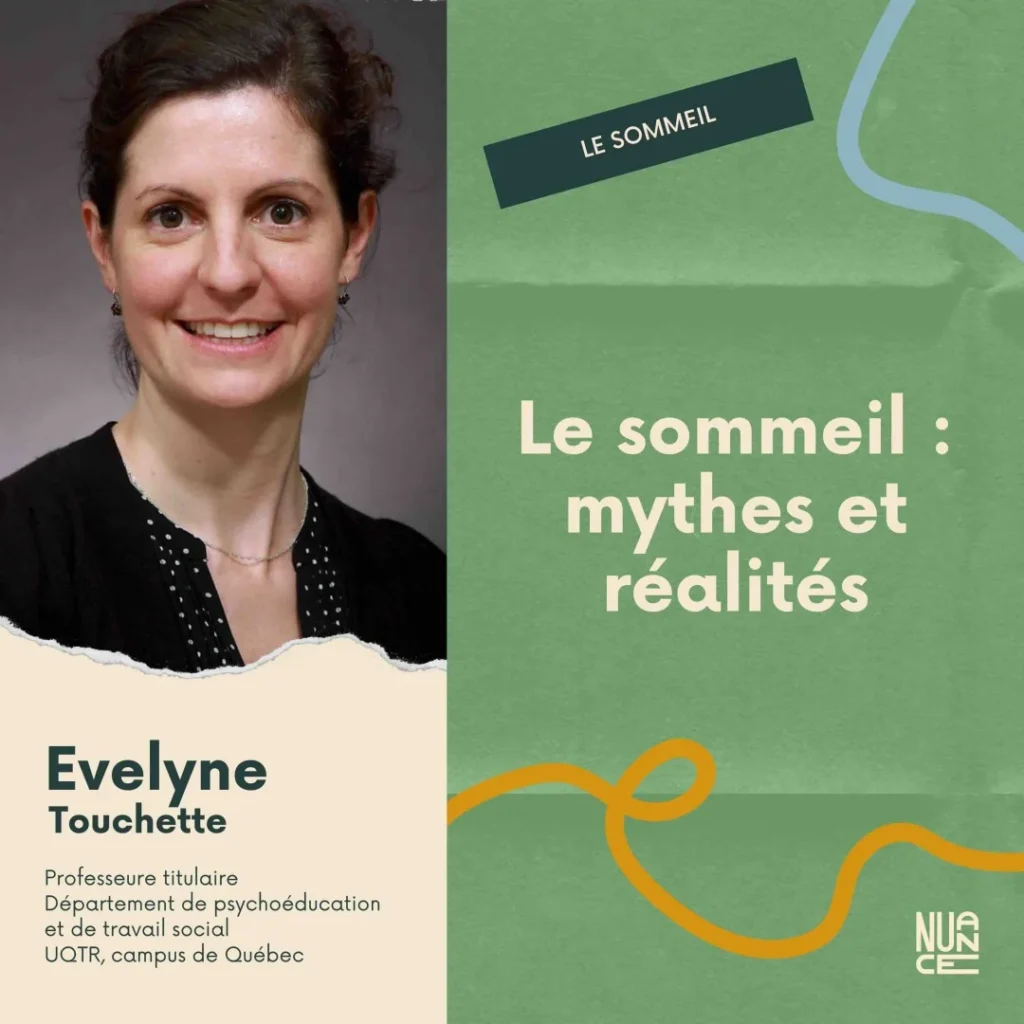
Through this podcast, you are invited to deconstruct some myths about sleep with Evelyne Touchette: some she herself believed before becoming a researcher, and others that still persist in our societies today.

This podcast reminds us that sleep cannot be ordered, but it can be prepared —and that by better understanding its mechanisms, we can act with greater gentleness, nuance, and respect toward our needs.

Listen to the podcast here : https://cqjdc.org/balado-nuance

Topics Covered Timestamps 🕒
Evelyne’s Sleep Myths :
  • You can catch up on / compensate for lost sleep. We often think that a lack of sleep can be easily caught up on or compensated for.
  • Sleeping a little (4–6 hours) is normal / the norm. It is actually very, very rare for people to only need 4 or 6 hours of sleep.
  • “The Early bird gets the worm” A discussion about chronotypes and the social pressure to wake up early.
  • Living on standard time is a good thing / neutral for the body. The negative effects of daylight saving time and time changes on the biological clock.
≈ 5 – 9 minutes
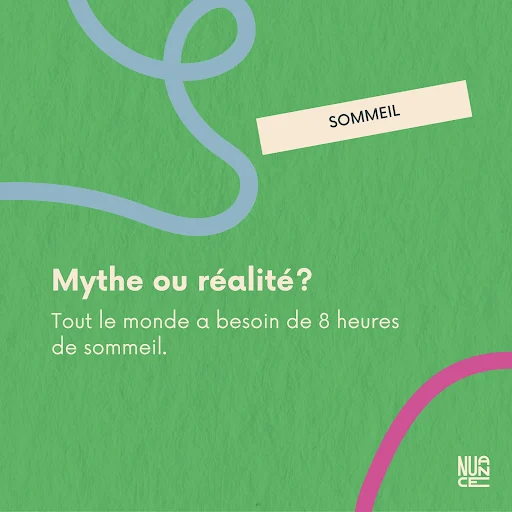
Myth 1 : Everyone needs 8 hours of sleep.
Norms versus individual needs. Recognizing our signs of lack of sleep. Little sleep train: 90-minute cycles and sleep architecture across the lifespan.
≈ 9 – 18 minutes
Myth 2 : Watching screens before going to sleep is relaxing.
Disconnecting with our phone, TV series, scrolling, etc. The effects of dopamine, the reward circuit, light, and stimulating content are discussed.
≈ 18 – 23 minutes
Myth 3 : Caffeine doesn’t affect (or barely affects) sleep in some people.
Tolerance to substances (coffee, energy drinks, etc.) and individual variability shed light on this myth. Not too late in the evening. A reflection on exercise and body temperature as a bonus.
≈ 23 – 28 minutes
Myth 4 : Melatonin is a simple and harmless solution (self-medication).
The effects of hormones versus vitamins, issues in children, over-the-counter availability, and unknown effects on development.
≈ 28 – 31 minutes

Melatonin in children: let’s talk about it together!

We know that melatonin raises a lot of doubts and questions among parents. And that’s normal! We would love to hear your questions and comments here so we can prepare our future tools on melatonin. Let’s talk about it together.

Sleep: Much More Than Just Energy.
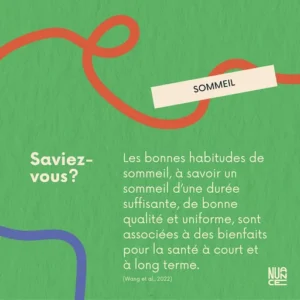
Sleep supports body regeneration, memory, learning, and emotion regulation, in both children and adults. One of the first causes to question. An excellent lever for prevention and intervention. Sleep is a key tool for mental health prevention and well-being, in interaction with nutrition and physical activity.
≈ 31 – 37
minutes
Preparing sleep throughout the day.
Sleep cannot be forced: it is prepared by supporting the biological clock through simple daily cues. Five letters, five cues: see this short video R.E.P.O.S. de Mission Sommeil.
≈ 37 – 43
minutes
Stress, life phases, and vulnerable sleep.
Sleep difficulties are often linked to stress or transitional periods in life. Supporting ourselves and acting on stressors is a priority. Tools are available here: Nuance podcast on anxiety and lifestyle habits or on www.stresshumain.ca
≈ 42 – 48
minutes
When and where to ask for help.
If sleep problems persist, it is important to consult health and sleep professionals within our healthcare system to rule out biological causes (sleep disorders, illnesses, etc.) and to access professional mental health, support, and educational resources (psychologists, CBT, psychoeducation, etc.). Let’s talk about it—let’s make sleep visible.
Here are some additional resources to explore:
  • Website for teens, parents, and professionals, project To not Doze Off :
    https://www.tonotdozeoff.com/
  • Website of the Canadian public health sleep campaign – Sleep on it :
    https://sleeponitcanada.ca/
  • Support here:
    Fondation Sommeil


≈ 48 – 53
minutes

Nuance is a captivating podcast designed specifically for young adults, offering a bold and in-depth exploration of various myths surrounding the challenges they face in adapting to their environment. Through authentic conversations and inspiring testimonials, Nuance debunks preconceived notions and offers nuanced perspectives on a wide range of topics.

At the heart of each episode, Nuance is dedicated to deconstructing these myths, providing practical advice and real-life stories to help listeners successfully navigate the complexities of adjustment difficulties. With a focus on mental health and well-being, the podcast also features discussions to support a holistic understanding of everyday issues.

Through its engaging and inclusive tone, Nuance provides a listening space where young adults can feel understood and inspired, while encouraging deep reflection on the pervasive myths that can sometimes hinder their development. An indispensable companion for those seeking to navigate life’s challenges with confidence, Nuance strives to promote understanding, resilience, and well-being in all its forms.” – excerpt from CQJDC

Inspiration and scientific sources:

    Recent posts

    CQJDC : Sleep: Myths and Realities

    Melatonin in children: let’s talk about it together!

    Sleep diary

    White noise

    Links between self-soothing and sleep autonomy

    Categories
    • Child (27)
      • Basics of sleep (9)
      • Falling asleep (4)
      • Guiding with confidence (8)
      • Nap (4)
      • Sleep disorders (5)
      • Vital need (3)
    • Parent (10)
      • Tips and tools (7)
      • Your vital need (3)

    Most popular articles

    marloes-hilckmann-IOYXAZ-spvs-unsplash
    Nightmares or night terrors: distinguish to act more effectively
    20 June 2023
    Many parents are confronted with their child's first nightmares or night terrors when they reach the age of one or two, and wonder how to react to help...
    Read more »
    calle-macarone-15wIddvL5dU-unsplash
    Insights on bedtime and sleep methods.
    10 February 2023
    Here is a three-part look at falling asleep and bedtime and sleep training methods with heartfelt scientific evidence to help you make informed decisions...
    Read more »
    enfant_bases-TRAIN
    Sleep train
    12 May 2022
    What is a sleep train? A sleep train is a succession of cars, which we also call "sleep cycles". These start around the age of 4 months. The sleep cyc...
    Read more »
    0-joshua-lanzarini-FGvQKMP-iXY-unsplash
    Pictograms, a tip for the pre-sleep routine
    28 October 2022
    Here are 7 printable pictograms to help make your pre-bedtime routine be fun and predictable. Studies show that routines: promotes falling asleep reduces...
    Read more »
    No items found

    Thanks to our funding partners:

    Knowledge brokering and web design

    Sign up for our newsletter!

    Disclaimer of liability

    “Learning to sleep like learning to walk” is an online resource that offers reliable information validated by scientists and specialists in sleep, health and child development.

    Warning. “Learning to sleep like walking” is not medical assistance and cannot replace the advice of a legally authorized health specialist. Only health specialists can provide you with medical advice, whatever your or your child’s condition, following a thorough examination and personalized care.

    Learning to sleep like learning to walk © 2026 under CC BY-NC-ND 4.0 licence

    cc.xlarge
    by.xlarge
    nc.xlarge
    nd.xlarge
    Conditions of use
    Privacy policy
    Manage cookie consent
    To provide the best experiences, we use technologies such as cookies to store and/or access device information. Consenting to these technologies will allow us to process data such as browsing behavior or unique IDs on this site. Not consenting or withdrawing consent can have a negative effect on certain features and functions.
    Functional Always active
    Storage or technical access is strictly necessary for the legitimate purpose of enabling the use of a specific service explicitly requested by the subscriber or user, or for the sole purpose of transmitting a communication over an electronic communications network.
    Preferences
    Storage or technical access is necessary for the legitimate purpose of storing preferences not requested by the subscriber or user.
    Statistics
    Storage or technical access used exclusively for statistical purposes. Storage or technical access used exclusively for anonymous statistical purposes. In the absence of a subpoena, voluntary compliance by your ISP or additional third-party records, information stored or retrieved for this sole purpose generally cannot be used to identify you.
    Marketing
    Storage or technical access is necessary to create user profiles in order to send advertisements, or to track the user on a website or on several websites with similar marketing purposes.
    • Manage options
    • Manage services
    • Manage {vendor_count} vendors
    • Read more about these purposes
    View preferences
    • {title}
    • {title}
    • {title}

    Mission Sommeil agrandit la famille!

    Découvrez notre première capsule vidéo